


The Four Disciplines of Execution (4DX)
“See a little, see a lot. See a lot, see nothing.”
-Dr. Kevin Elko
My philosophy in teaching and coaching has always been to keep it simple. When things get too complicated, especially with over-analytical adolescents, people often get O.B.E., a military acronym for “overcome by events.” An example in the military would be a in a flight simulator. At first, the pilot takes off and is asked to perform some maneuvers; easy enough. Next, mountains are introduced; then an enemy plane. The difficulty increases, but still a manageable task. Then, more enemy planes or other conditions are added, and at some point, the participant will likely become OBE.
In the business of Division I Football, coaches and staff work at least 72 hours per week in the off-season, the slow time of year. There are many things football staffs have to prepare and handle throughout the off-season. McChesney, Covey, and Huling (2012) would categorize the whirlwind in the college football off-season as the countless hours reviewing schemes, preparing the team for Spring ball through personal and academic accountability and strength training, recruiting high school prospects including prospect camps, and getting ready for training camp and the season, not to mention social, media, and development engagements, and community outreach with the local coaches and players. Introducing a new virtual reality football simulator will require a great amount of time to set up the proper schematic and spatial accuracy for the machine to be beneficial for the student-athletes to use.
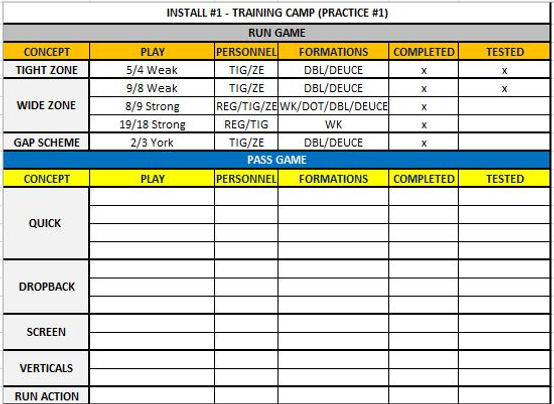
To frame the 4 Disciplines of Execution below, in football, we call the information being taught the players on a particular day an installation or "install." So on day 1 of Spring ball or training camp, the coaches will teach the players Install 1, which will be a certain set of formations, plays, fronts, coverages, and the wide array of terminology used for the operation of those plays and schemes. The next day, the coaches will Install 2, then Install 3, etc. There may be a few days between installs, depending on how much they want to do with their players, and that may vary team to team.
Discipline 1:
Focus on the Wildly Important Goals
-
Both the Offensive Staff and Defensive Staff will have Installs 1 through 5 programmed into the Virtual Reality system before the incoming Freshmen report on June 23, 2019.
Discipline 2:
Act on Lead Measures
-
Lag Measure: Installs successfully inputted into Virtual Reality module
-
Lead Measure: Number of completed installs
-
Lead Measure: Installs tested by each position coach or graduate assistant to test schematic and spatial accuracy
Discipline 3:
Keep a Compelling Scoreboard
Discipline 4:
Create a Cadence of Accountability
-
Each Monday leading up to 1st year student report day, the staff will invest 30 minutes of the normal staff meeting to discuss progress, positive advancements, improvements needed, troubleshooting, and overall thoughts of the project up to that point
The 4 Disciplines of Execution

The 5 Stages of Change
The 4 Disciplines explain what needs to happen to start creating change with the program. The 5 Stages below will explain how to implement that change and give clear expectations as to what to expect throughout the process.
Stage 1: Getting Clear
As McChesney et al (2012) explained, implementing the WIG is going to require clear direction from the top-down, and strong engagement and commitment from the bottom-up. In terms of this project the head coach needs to make sure the staff understands what results he expects from the staff in regards to the creation and use of the virtual reality football simulator. The Offensive and Defensive staffs will need to make sure they have thoroughly discussed the content, which is this situation would be the playbook and the order of installation. The staffs will also need to be sure that the workload is delegated appropriately to make sure the modules are being completed expeditiously, and are done with precision and accuracy.
Stage 2: Launch
Spring Ball, where the team is permitted to hold 15 practices over five weeks, is a good time to start to finalize the playbooks for the upcoming football season. During the off-season, there is a limited amount of time for organized football activity allowed per the NCAA, so teams need to take advantage of when they are able to meet, practice, and install the football principles for the Fall season. Based on this timing, as part of the Spring Ball organization meeting in the middle of March, the head coach will also explain the expectations of the WIG, the benchmarks for installs in the virtual reality program, the tracking system, and the weekly update in the staff meetings to follow.
Stage 3: Adoption
Once the expectations have been explained, the Offensive and Defensive Coordinators will take charge of their units to make sure all the steps are accounted for. The most difficult part of this step is that there are not many live examples of virtual reality being fully incorporated into a college football team. The staff will have to work closely with the programmers, IT, and the video department to get things started correctly. The setup is going to be the most difficult and time-consuming part of the process. Once the initial templates are created though, production should increase significantly.
Stage 4: Optimization
By the time setup is complete, Spring Ball should be coming to a close, and coaches and staff will be able to start fine-tuning the schematic adjustments before they go on the road recruiting. The people working with programming along with the Graduate Assistants and Quality Control Assistants can really start to hone in on the spatial and schematic accuracy before putting the whole system to test with the position coaches and coordinators. By this time the staff will have met at least eight times on the progress of the virtual reality project, and will be starting to become experts in the craft.
Stage 5: Habits
As I mentioned, the SETUP of the virtual reality football simulator is going to the hardest part of this process. In football and sports in general, people compete to try to be the best. With the growth mindset already instilled among the staff and the student-athletes, a program that is going to help players get more reps without over-exerting their or their teammates bodies is going to be an easy sell. The process of getting to that point is what is going to take the time and commitment from the staff, and I believe the 4DX model above will be very helpful in implementing change.
The motivations listed in the Influencer Strategy of this project will be integral upkeep and success of the virtual reality system. The more work the staff puts into the programming, the more the players will get out of it. It will take the 4DX model to get the process started because it is going to take some trying times to get the program set up. As alluded to in the 4DX book, I can imagine there will be a plateau in production when it comes time to building the template in the system. There will be technical and issues along the way, not including the whirlwind of practice, recruiting, family, etc. With clear expectations and keeping the site of the goals, the virtual reality football simulator is going to be a great benefit to all.
References:
Grenny, J., Patterson, K., Maxfield, D., McMillan, R., & Switzler, A. (2013). Influencer: The new science of leading change. New York: McGraw-Hill Education.
Lewis, J. (2012). The Legal Examiner. Lessons From Dr. Kevin Elko. Retrieved from: https://www.legalexaminer.com/uncategorized/lessons-from-dr-kevin-elko/
McChesney, C., Covey, S., & Huling, J. (2012). The 4 disciplines of execution: Achieving your wildly important goals. New York, NY: Free Press.